Showing posts with label business. Show all posts

February 1, 2017

How to Write a Politically Correct Business Email

Dear Bubba,
I know that I really ought to be raising this issue with Jim Bob. But, as anyone who's met him knows, he's a stupid S.O.B. and lazy to boot, so therefore unlikely to either understand or care about my concerns.


Dang. That's no good.

Dear Bubba,
I know that I really ought to be raising this issue with Jim Bob. But I think that it falls outside his area of expertise. I hope that you will be able to help me take care of this problem, or recommend someone else who can. Please don't bring Jim Bob into this, he's dumb as a slug and mean as a hornet and you'll only make him confused and angry.


Nope. Dang.

Dear Bubba,
I know that I really ought to be raising this issue with Jim Bob. But I think that it falls outside his area of expertise. I hope that you will be able to help me take care of the problem, or recommend someone else who can. I don't think it's a good idea to bother Jim Bob with this right now, as he has other priorities. If we can come up with a reasonable solution quickly, I think we'll be able to implement it before Jim Bob has another one of his temper tantrums and goes whining to the boss like a spoiled five-year-old.


Nope. Can't do it. Try again.

Dear Bubba,
I know that I really ought to be raising this issue with Jim Bob. But I think that it falls outside his area of expertise. I hope that you will be able to help me take care of the problem, or recommend someone else who can. I don't think it's a good idea to bother Jim Bob with this right now, as he has other priorities. If we can come up with a reasonable solution quickly, I think we'll be able to implement it without interference.
Thank you for your time.


September 16, 2014

Business Idea: The Kitchenette

The Idea

When people downsize their living spaces, as many are doing these days for economic and other reasons, extraneous rooms like the home office and the garage workshop disappear. Businesses have stepped in to fill those gaps: Coworking spaces provide offices for people who work at home or on the road but sometimes need a fully functional traditional office space. Makerspaces provide workshops for people who don't have the space for a large workshop or the desire to buy a ton of expensive, specialized tools.

But one room that remains, even in the tiniest studio apartments, is the kitchen.

Real Life, NYC


If you eat out all the time, a kitchen is inconsequential. But it's harder to eat healthy that way, not to mention a lot more expensive. If you want to have fresh fruit and vegetables, you need a fridge to store them in. That takes space. If you want to save money by buying in bulk, you need storage space. If you want to prepare meals ahead of time, freeze them, then heat them up, that takes a lot of space. And to make home cooking enjoyable, you really need a fair amount of counter space to work on, not to mention a decent stovetop, an oven that can fit a half-sheet pan or casserole dish, a microwave large enough to reheat things, and a sink deep enough to make filling up pots and washing up easy, plus a dishwasher if you're feeding more than two people on a regular basis.

What if there were a place near your home where you could go to both cook and store your food? Maybe even eat it there? A family of any size could have a meal together even if their home is too small for a separate kitchen table to be practical. People could save money by buying frozen bulk items even if their apartment freezer is a 6"x12" shelf.

Now, I know that there are already businesses like Simply Supper and Dream Dinners, where you can prepare frozen meals that you reheat at home later. But this business model assumes that you have a freezer at home large enough to store all those meals and an oven large enough to reheat them. Those businesses are great for busy middle-class families.

But one reality of our current economic climate is that the middle class is disappearing. If you want your business to succeed these days, you're better off selling luxury goods and services to the wealthy or inexpensive essentials to lower-income folks. The Kitchenette targets this second demographic.

How many people would be able to afford a nicer place to live if they didn't have to worry about having a fully functional kitchen? How much space is wasted by ovens and stovetops that never get used? How many people would love to cook homemade meals, but are hampered by a lack of space and equipment?

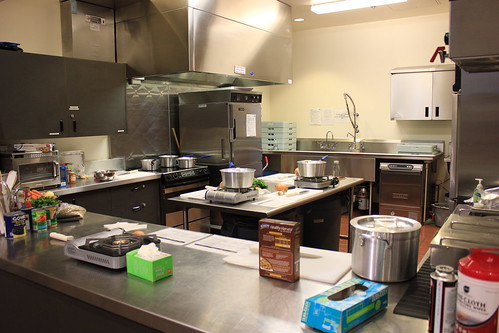
Just like a Makerspace provides an environment and tools that are impractical for everyone to have at home, The Kitchenette would have all the large, bulky, useful appliances that make cooking fun and easy, like waffle irons, food processors, and stand mixers. And of course there would be helpful staff on hand to show you how to work unfamiliar tools and answer cooking and meal-planning questions.

Cooking for a Healthy Future-Tacoma April 17 080

The Business Model

Of course, the real question is, how do you make money? 

Using the Coworking model, people could pay a monthly fee for unlimited kitchen use, or pay per-use. There would also be a charge for pantry and fridge/freezer space rental, x amount for so many cubic square feet. This space would be locked, so everyone feels secure that their food won't be taken by another customer. Unlike the businesses linked above, you would bring your own ingredients (though The Kitchenette could have some basic spices on hand, such as salt, pepper, and cinnamon). The Kitchenette could also offer cooking classes, which would be a great marketing tool for recruiting new customers.

But since this business is targeting low-income families and individuals, what about those who can't pay much? People would be allowed to pay for only the pantry and fridge space, then make up the monthly membership fee by helping clean up a set number of hours. This would not only make The Kitchenette more affordable, but also cut down on maintenance costs and give customers a sense of ownership.

The ideal location for The Kitchenette is near a grocery store, in an urban center with dense housing. The business would be a boon for any grocery or bulk store nearby, because it would encourage people who otherwise might not buy much food to purchase more.

Imagine families of any size able to sit down together and eat a home-cooked meal. Imagine people rediscovering the lost art of cooking together. Imagine healthy, sustainable food replacing processed fast-food in many families' diets. This is my vision for The Kitchenette.


October 25, 2013

Leadership Has Nothing to Do with Job Titles


The other day a coworker posted a link to a really great article, "Why Your Innovation Leadership Training Will Fail."  The author, Henry Doss, explains how the systems and culture of a workplace affect innovation, for good or ill, far more than its leaders do.

I was discussing this article with my husband, and we discussed the concept of "innovation leadership training." He pointed out that this is the kind of training usually given to managers in an organization. "But managers aren't leaders," he said.

That was something that hadn't occurred to me, but he's right. Think about who the leaders are in your workplace. Some of them might be managers, but some of them might be people with no official leadership title. The people who get things moving, who inspire others - they can be anyone, at any level.

And, conversely, there may be managers who are not leaders. For certain organizations, this is fine: managing is a different skill set than leading, and sometimes you just need someone who can handle logistics and politics in that role. But sometimes, if a group that needs a leader lacks one, that can cause problems.

Look around you today and forget about job titles for a minute. Who are the leaders around you? What is being done to nurture their talent for leadership?

January 24, 2013

You Are the Reason for My Success

This week, I learned that one of the reasons I am successful is that I have been lucky enough to have good friends. Specifically, good women friends.

This past Monday I attended TEDx Columbia SC, an independent local TED event. One of the speakers was Dr. Linda Salane, director of the Leadership Institute at Columbia College. She talked about what's keeping women from being successful in business.

One of the problems she addressed was "what women believe about women." In surveys, women say they'd prefer to work with men instead of other women. We apparently think other women are "over-dramatic back-stabbers."

Sitting in the audience and listening to Dr. Salane, I felt both disturbed and surprised. Sure, I knew there were some awful women out there. Heck, there are awful men, too. But there are plenty of women who are good people, people with whom I'd love to work.

Last day of school, 8th grade
It struck me that maybe I've just been fortunate in my friends. From nursery school through elementary school, high school through college, young adulthood on into motherhood, I have been privileged to call some truly wonderful women my friends. They kept my secrets, shared jokes and smiles and memories. They told me when I was being stupid, but stayed friends with me anyway.

So, to all my friends, thank you. Because you taught me that I can trust other women, and work with other women, I've been successful in my career.

To moms of girls, teach them to be good friends and help them find good friends. You'll be setting them on the path to success.

December 5, 2012

My Presentation to the CEO Roundtable

Today, President Obama and House Speaker Boehner are making presentations to an organization called the Business Roundtable. According to their web site, they are "an association of chief executive officers of leading U.S. companies." They wield a lot of political and economic influence, so getting these CEOs behind one's deficit-reduction plan would be a coup.

I'm sure Obama and Boehner will each present their plans to avoid the austerity bomb (fiscal cliff), and make the same arguments we've all already heard. But if I had the opportunity to address this group, here's what I would say. I'm not an economist, so I'm kind of talking out of my ear on this, but it would be interesting to see their reaction.

My Imaginary Presentation to the Business Roundtable

Look at this chart:


The red line is the percentage of GDP represented by corporate profits. The blue line is the percent of GDP represented by wages. These days, the word among VC's is that consumer-focused startups are out, enterprise-focused startups are in. You can see why: the enterprise is where the money is.

The only problem is, that blue line represents your customers. 

Take a look at this:


Look at the red line. It shows the change in available disposable income for your customers. It's recovered since the recession ended, but it's still down from the pre-recession high, and on a recent downward trend.

Think about this: Your employees (pointing at random guy in front row) are your customers (pointing at another random guy), and vice versa. If your customers don't have enough disposable income, they will not buy your products. Profits will suffer. Share prices will drop.

There are two solutions to this: the government solution, and the free-market solution. In the government solution, the government raises taxes on your income and your companies' income. The government subsidizes your employees' basic needs, like food and health care, that they can't afford. 

The other solution, the free-market solution, is for you to choose to raise your hourly wages in the U.S. and give people who want to work full-time the opportunity to do so. Your employees will have more disposable income, they will be able to take care of themselves, and the government doesn't have to get involved. As a matter of fact, that would increase taxable revenue while decreasing entitlement spending. And the potential increase in demand would ensure that all of you still have customers who can afford your products five, ten, fifteen years from now.

Either way, you're going to be losing money in the short term. But will that money go towards increased government entitlement spending, or will you allow your hard-working employees to earn it the old-fashioned way? It's your choice.

March 6, 2012

Incentives Matter (or Why the Lab No Longer Has a Cafeteria)

Many people I know here in Aiken work at Savannah River National Lab. It's part of the Savannah River Site, an old nuclear weapon manufacturing facility that's currently being cleaned up and repurposed. SRNL is run by both the Department of Energy and Savannah River Nuclear Solutions, a consortium of companies put together to manage various aspects of the site and the lab.

Warning: This article may contain an
unsafe level of acronyms
After reading this article about problems at other national labs, I thought it worth writing about a couple of anecdotes I've heard about SRNL.

As a government-funded endeavor, the site and the lab have to get their funding re-approved every so often. It makes sense to have a set of goals the DOE and SRNS have to meet to ensure taxpayers are getting their money's worth. Theoretically, the success of the site and the lab can be measured by these metrics, and the funding and management contracts adjusted accordingly. Naturally, DOE and SRNS management work very hard to meet these goals and to collect the monetary incentives they get by meeting them.

Creating metrics by which the people managing SRS and SRNL can be judged makes sense, but only if the metrics themselves make sense.

Tear It Down

I know the chicken tetrazzini was bad,
but come on!
WSRC, the consortium which managed the site before SRNS, was charged with removing a lot of the old weapons manufacturing facilities. They were required to remove a certain amount of square footage and would get bonuses for removing more. Unfortunately, the contract did not specify what kinds of buildings they had to remove.

So WSRC bulldozed tool sheds, garages, even the lab's cafeteria - much simpler than removing manufacturing facilities full of old radioactive junk. They met their goal and got their bonus (though it's worth noting they did not get their management contract renewed), and the site was left with a bunch of radioactive junk that still needed cleaning up.

Fire It Up

Admittedly, there were problems
with the old procurement system.
This next anecdote particularly resonates with me, as I help program and install large enterprise IT systems.

The procurement system at the site is a mess. It was a mess before SRNS arrived, and it remained so after they took over. Something had to be done, so procurement was charged with installing a new software system to streamline purchasing and bill paying.

The software was built and installed, and the procurement department had a party to celebrate meeting their goal. Several weeks later, the department was in trouble because no one could figure out how to actually use the new system to pay bills and the past due notices were piling up.


Be Careful What You Ask For

In any large company, it makes sense to have goals and metrics with which to judge success. Upper management can't track the progress of every project and every group - that's why there are levels of management to synthesize things and present the big picture.

But success is only real if the metrics by which it's judged measure things that matter. It's important to spend as much care researching and drafting those metrics and goals as it is trying to meet them.